

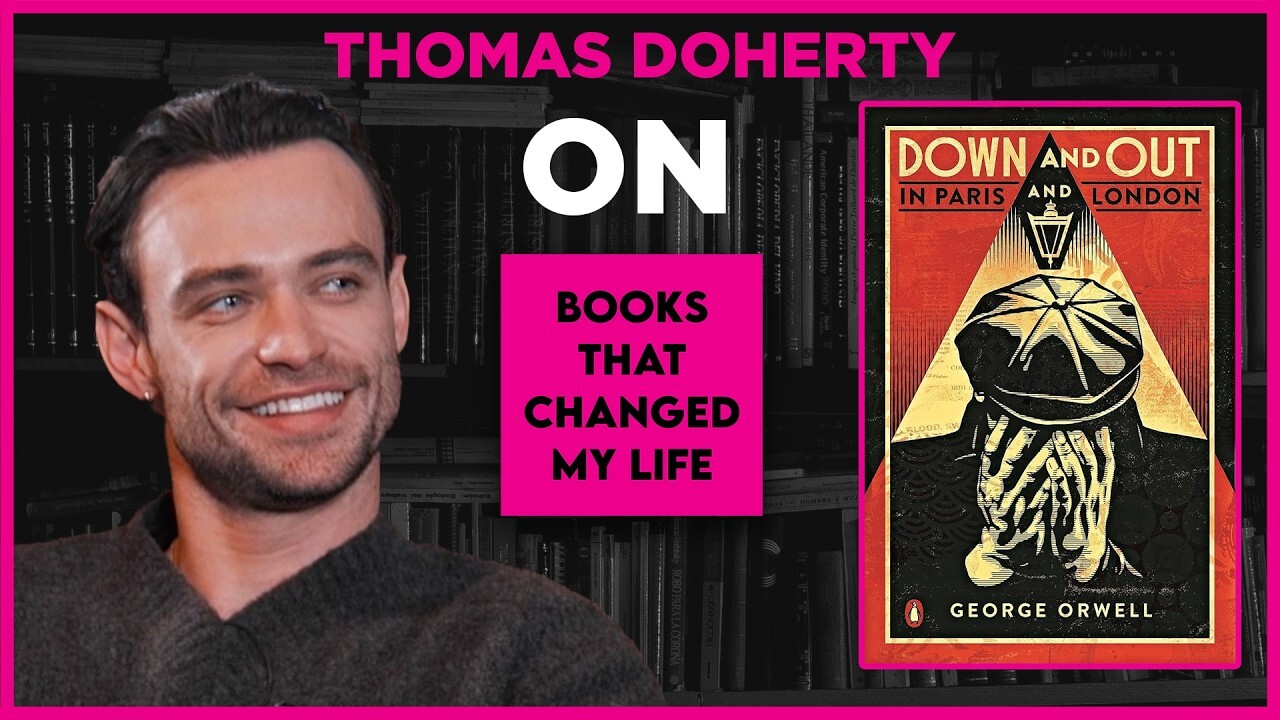
We often view our lives through the lens of our own immediate comforts. However, this conversation reveals a more profound truth. Stepping into the shoes of those at the margins can fundamentally rewrite your worldview.
In this episode of Books That Changed My Life, actor Thomas Doherty reflects on Down and Out in Paris and London by George Orwell. This memoir did more than recount a struggle with poverty. It provided Thomas with a new framework for empathy and a deeper understanding of social structures. His journey through this gritty narrative mirrors the exploration of The Power Broker and Systemic Power: How We Build Our World.
About the Guest: Thomas Doherty
Thomas Doherty is a Scottish actor known for his standout roles in Gossip Girl, The Lodge, and Descendants. Born in Edinburgh, Thomas has moved from musical theater to high-profile television dramas. While he often plays characters of privilege, Thomas remains deeply grounded. His interest in Orwell reveals a man who looks beneath the surface of fame to understand the complexities of the human experience.
About the Book: Down and Out in Paris and London
George Orwell wrote this memoir in 1933 as a vivid account of living in extreme poverty. The book documents his time working as a “plongeur” (dishwasher) in Paris and his days as a tramp in London. Orwell argues that poverty is not a character flaw. Instead, it is a grueling, full-time job that strips away a person’s dignity. It remains a definitive text for those seeking to understand the “invisible” workers who keep society running.
You can explore more conversations about transformative literature in the Books That Changed My Life archive. Our community resources also include a dedicated line of series-inspired apparel and accessories available on our website.
How Orwell Ends the Illusion of “Us vs. Them”
Thomas explains how Orwell’s writing stripped away his preconceived notions about class. Growing up, certain social boundaries felt permanent. Down and Out changed that perspective by showing how easily a person can fall through the cracks.
The book challenged the idea that some people are simply “destined” for struggle. Instead, Thomas used Orwell’s observations to cultivate a more active form of empathy:
- The Dignity of Work: He gained a new respect for service workers. He realized the intense labor required for the comforts many take for granted.
- Breaking the Stigma: Thomas discusses how the book humanizes those experiencing homelessness. It shows that everyone has a complex history and a name.
- The Thin Line: The narrative highlights the fragility of security. It reminds the reader that circumstances can change in an instant.
Consequently, he shifted from a passive observer to someone who seeks to understand the “unseen” parts of the world. This commitment to character and human connection reflects the principles shared in our episode with Rob Riggle: Manners, Character, and Dale Carnegie.
Reinvention Through Awareness
The book teaches that growth happens when you allow your heart to be broken by the reality of others.
Thomas uses this awareness to ground his work as an actor. He views his craft as an opportunity to portray the “human-ness” in every character, regardless of their status. This approach requires the discipline Orwell displayed:
- Observation over Judgment: Thomas practices looking at the world without immediate labels.
- The Power of Experience: He values real-life experiences and struggles as the best education for a creative mind.
- Sustaining Empathy: He keeps the lessons of the “plongeur” in mind to stay humble in a career defined by visibility.
Challenging Inherited Social Bias
Thomas’s story shows a progression from a localized worldview to a global sense of responsibility:
- Inherited Perspective: Viewing social classes as fixed or inevitable categories.
- Internal Conflict: Feeling a disconnect between his own success and the visible struggles in society.
- The Turning Point: Reading Orwell and realizing that “the poor” are individuals with distinct voices.
- Personal Integration: Committing to a life of empathy and using his platform to bridge social gaps.
Why This Book Still Matters
This conversation addresses universal tensions found in our Books That Changed My Life series:
- Empathy versus Apathy.
- Social Class versus Human Dignity.
- Privilege versus Perspective.
FAQ
- Why did Thomas Doherty choose this book? It significantly shifted his perspective on social hierarchy and the way he interacts with people from all walks of life.
- What is a “plongeur”? It is a term Orwell used for a dishwasher in a Parisian hotel, a role that represents the lowest tier of the labor force.
- Does the book focus more on Paris or London? It is divided into two halves. The first focuses on labor in Paris, while the second explores the life of a transient in London.
- What is Thomas Doherty’s latest project? Thomas continues to star in major film and television productions, often bringing this grounded, Orwellian empathy to his roles.
Final Thoughts
Down and Out in Paris and London served as a moral wake-up call for Thomas Doherty. It proved that the most important stories often happen in the places we usually look away from. It turned an observer into an empathetic storyteller. Through Orwell’s lens, Thomas found a way to see the world—and himself—with much greater clarity.
