

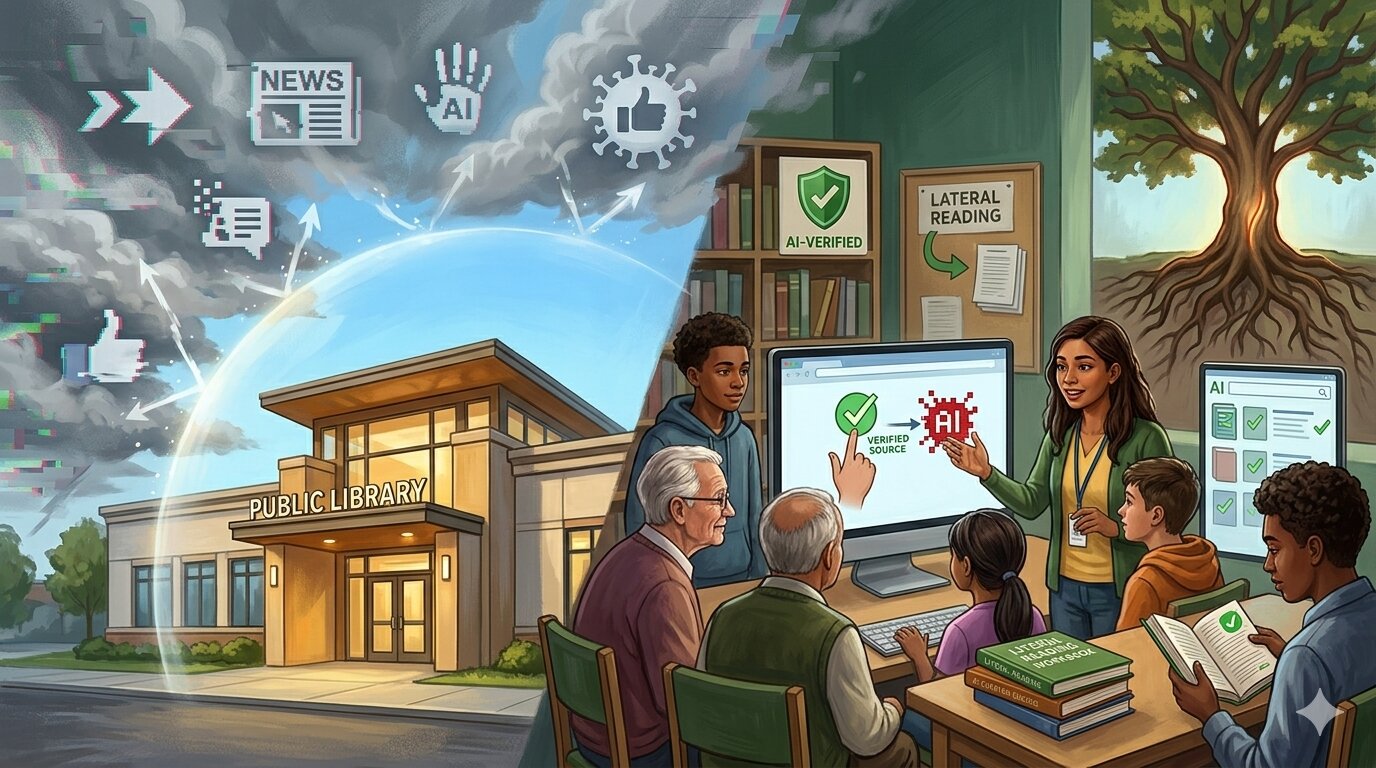
Public libraries are 2026’s primary frontline defenders against the spread of misinformation and digital deception. These institutions serve as essential hubs where professionals provide the tools, training, and verified resources necessary for citizens to navigate an increasingly complex media landscape. Public libraries and misinformation are now at the center of a national conversation regarding the protection of objective truth in the digital age.
This role has evolved from simply providing access to books to actively teaching digital information literacy (DIL) to diverse populations. As artificial intelligence continues to lower the barrier for creating convincing fake content, librarians have stepped into the role of expert navigators. They help patrons distinguish between credible reporting and sophisticated AI-generated fabrications that often bypass traditional filters.
The endurance of the library as a trusted institution is rooted in its commitment to neutral, evidence-based service. In a period marked by deep societal polarization, the library remains one of the few physical spaces where individuals can access high-quality data without commercial or political interference. This article examines the specific strategies libraries use to combat falsehoods and why their presence is more vital than ever in 2026.
How Librarians Teach Modern Media Literacy
Modern media literacy training in libraries has shifted from basic source checking to a method known as “lateral reading.” Instead of spending time analyzing a single suspicious website, librarians teach patrons to open new tabs. They check what other trusted authorities say about that source. This technique, championed by organizations like the American Library Association (https://www.ala.org), allows users to verify claims in real-time.
Many libraries now host “SIFT” workshops—an acronym for Stop, Investigate the source, Find better coverage, and Trace claims back to the original context. These sessions focus on the emotional triggers that misinformation often uses to go viral, such as outrage or fear. By teaching patrons to recognize their own cognitive biases, librarians empower them to pause before sharing unverified information.
The curriculum also includes practical lessons on identifying “imposter content.” These materials look like a legitimate news organization or government agency. Patrons learn to inspect URLs, check for digital watermarks, and use reverse image searches. This hands-on approach transforms passive consumers into active, critical evaluators of information.
The Rise of AI-Generated Content in Library Collections
The explosion of generative AI has created a unique challenge for library collection management in 2026. Librarians see a massive influx of AI-generated books. These range from low-quality travel guides to “hallucinated” historical accounts. To protect the integrity of their shelves, libraries implement strict new selection policies to filter out unreliable, machine-made texts.
A 2026 report from the Salt Lake County Library highlights that transparency is the most important factor when dealing with AI. Many libraries now require publishers to disclose if AI was used for text or illustrations. They prioritize works that have undergone human fact-checking. This prevents the “hidden” infiltration of AI biases and errors into the public record.
- Libraries create “AI-verified” badges for their digital catalogs. These signals tell readers that a human professional reviewed the content for accuracy.
- Collection developers use advanced screening tools. These tools detect machine-generated patterns in new acquisitions to keep local history and science sections grounded in reality.
- Some institutions created specific “AI Literacy” sections. Patrons can intentionally study machine-generated works here to understand their limitations and potential for deception.
Why Libraries Remain the Most Trusted Institutions
Public libraries continue to rank among the most trusted institutions in the United States. Trust in traditional media and government has declined, but library confidence remains high. A 2026 survey by Evidence For Democracy (https://evidencefordemocracy.ca) shows that 78% of participants chose the library first for reliable community information. This trust comes from the library’s mission to provide equitable access without a profit motive.
Librarians act as “information fiduciaries.” They have a professional and ethical obligation to protect patron privacy and data accuracy. Library services facilitate learning and civic engagement rather than following social media algorithms. This drive for personal enrichment is often sparked by outside stories, such as the life-changing book behind Raegan Revord’s growth, which reminds patrons of the transformative power of verified literature.
The physical presence of the library also reinforces its credibility. Digital content can be deleted or altered in seconds. However, the physical archives and expert staff of a library provide a sense of permanence and accountability. Patrons know that professional standards back the information they receive.
The Broader Social Meaning of the Information Fight
The fight against misinformation protects the health of the democratic process. When a society lacks shared facts, it cannot address issues like public health or local infrastructure. Libraries act as the “connective tissue” that keeps the community grounded in a common reality.
In 2026, the spread of “malinformation” has become a tool for social fragmentation. This involves true information used out of context to cause harm. Libraries counter this by providing the full context and historical background for complex news cycles. They serve as a stabilizing force in neighborhoods susceptible to disinformation campaigns.
This trend reflects a broader shift toward “intentional information consumption.” People are moving away from the chaotic “firehose” of digital feeds. They now favor curated, verified knowledge. Just as there are books that inspired Olympic athletes to reach peak performance, curated library collections inspire citizens to reach peak information awareness.
Protecting Communities from Targeted Deception
Misinformation rarely affects everyone equally. It often targets marginalized groups, including Indigenous communities and gender-diverse populations. These groups frequently face deepfake campaigns or false claims designed to restrict their access to services. Libraries in 2026 respond by creating targeted outreach programs to help these communities defend themselves.
Librarians who speak multiple languages are essential in these efforts. They translate fact-checking resources and host town halls. Residents discuss the rumors they see on private messaging apps like WhatsApp or Signal. By building deep personal relationships, librarians debunk falsehoods before they lead to physical or psychological harm.
- Specialized “Community Truth” task forces work with local leaders. They monitor the spread of harmful rumors in specific neighborhoods.
- Multilingual information kits go to new immigrants. These help them navigate the complex landscape of official government documentation.
- Libraries provide free access to premium fact-checking databases. This ensures that financial status does not limit a person’s access to truth.
The Future of the Public Information Officer
The role of the librarian now merges with that of a “public information officer.” In 2026, libraries are active monitors of the local information ecosystem. They work with schools, local news outlets, and health departments. They ensure that accurate data flows to the people who need it most.
As AI continues to evolve, libraries will become the primary trainers for “AI skepticism.” This involves teaching people to assume that digital media may be altered until proven otherwise. This critical mindset is the new survival skill of the 21st century. Libraries are the institutions best equipped to teach it on a massive, public scale.
The success of these programs demonstrates that the library is a blueprint for the future. By combining human expertise with a commitment to the public good, libraries prove that truth is a community resource. The fight against misinformation is long, but with libraries on the front lines, the public has a powerful ally.
Restoring the Foundations of Public Truth
The efforts of public libraries in 2026 prove that education and transparency can meet the challenge of misinformation. By prioritizing digital information literacy, libraries provide a vital service to a confused public. They remain the most reliable source of accurate information. Their only goal is to serve the needs of their community.
As we look toward the end of the decade, the library’s role as a defender of truth will become more prominent. These institutions provide the physical and intellectual space necessary for a healthy society. In a world of digital shadows, the library remains a beacon of clarity and a guardian of our shared reality.
Frequently Asked Questions
How do librarians decide what content is misinformation?
Librarians use professional standards and selection policies to evaluate content. They look for expert consensus from peer-reviewed journals and government data. These established organizations ensure that library materials are grounded in factual reality.
Can libraries really stop the spread of AI-generated fakes?
Libraries cannot stop the production of AI fakes, but they effectively teach people how to spot them. They provide training on digital watermarks and lateral reading. These tools help patrons identify machine-generated content and prevent it from influencing their decisions.
Why should I trust a library more than a search engine?
Search engines use algorithms that prioritize engagement or advertising, which can create filter bubbles. Libraries are non-profit institutions managed by humans. These professionals are ethically committed to providing neutral, diverse, and verified information.
